✍ Words Per Minute Writing Calculator
Calculate your writing speed or estimate how long your writing project will take to complete
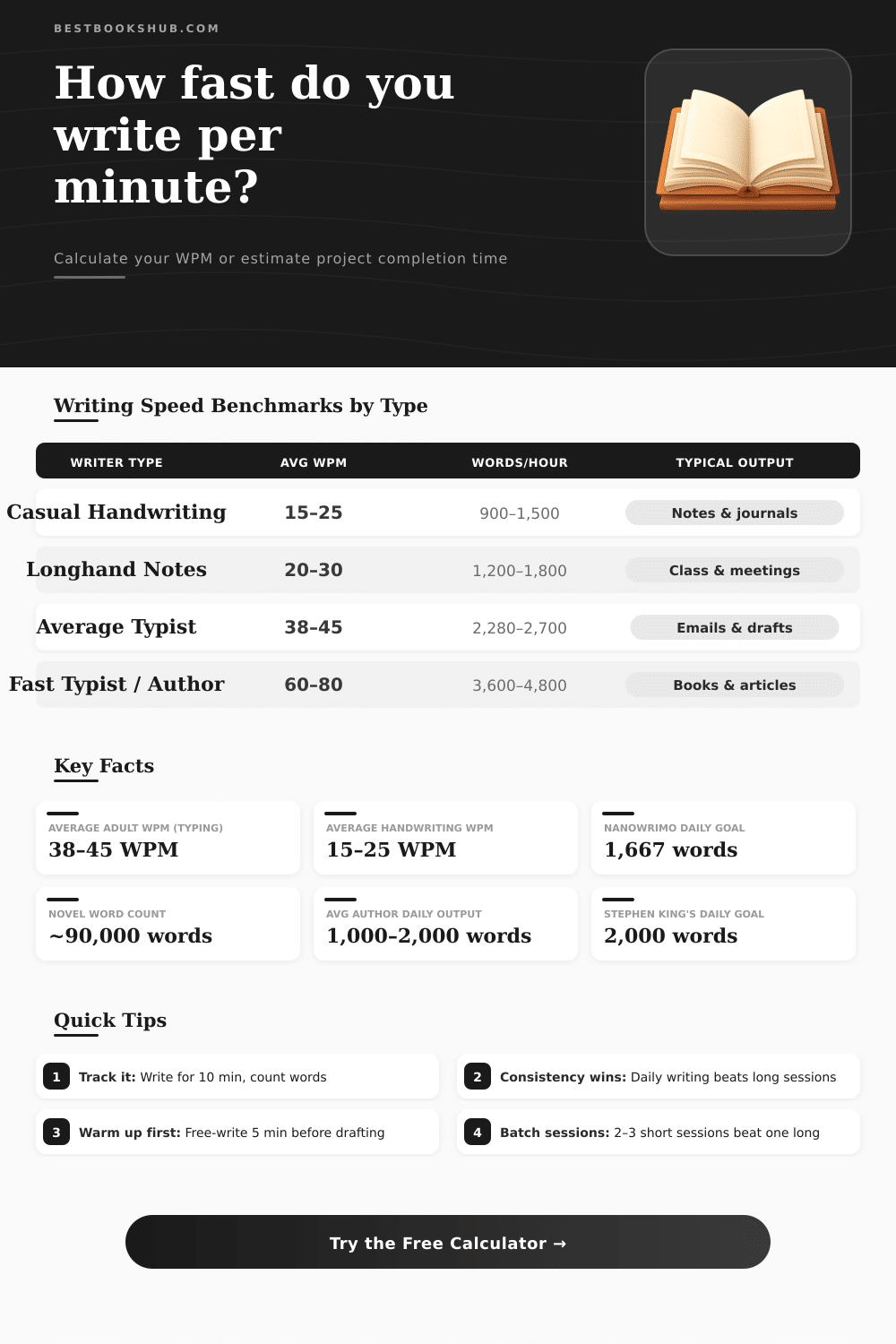
| Writer Type | Avg WPM | Words / Hour | Typical Output |
|---|---|---|---|
| Casual Handwriting | 15–25 | 900–1,500 | Personal notes, journaling |
| Longhand Note-Taker | 20–30 | 1,200–1,800 | Class notes, meeting minutes |
| Average Typist | 38–45 | 2,280–2,700 | Emails, blog posts, drafts |
| Proficient Typist | 55–70 | 3,300–4,200 | Freelance writing, journalism |
| Fast/Professional Author | 70–100 | 4,200–6,000 | Full-time authors, fast drafters |
| Speed Typist | 100+ | 6,000+ | Transcription, competition typing |
| Author | Daily Words | Writing Speed Notes | Books / Year (approx) |
|---|---|---|---|
| Stephen King | 2,000 | Writes every day, including holidays | 1–2 |
| Nora Roberts | 2,000–3,000 | Extremely prolific, full-time writer | 4–6 |
| James Patterson | 1,500–2,000 | Co-writes many titles, very structured | 10+ |
| Neil Gaiman | 200–1,500 | Varies widely by project and mood | 1 |
| Ernest Hemingway | 500–1,000 | Stopped at a high point daily | ~1 |
| Maya Angelou | 1,000–2,000 | Worked in hotel rooms, intensely focused | ~1 |
| John Grisham | ~1,000 | Wrote before work each morning | 1 |
| Danielle Steel | 3,000–5,000 | Notoriously prolific, writes non-stop | 4–5 |
The average typing speed is around 40 words per minute. Most typists use some system of hunt and peck, and their speed ranges a lot. For higher output you commonly aim for 60 to 70 words per minute.
DISCLOSURE: This post may contain affiliate links, meaning when you click the links and make a purchase, I receive a commission. As an Amazon Associate I earn from qualifying purchases.
Maybe it takes enough practice to reach 100 words per minute but going to 60, 70 should not be that difficult.
Typing Speed and Accuracy
Professional typists usually use physical keyboards at speeds between 43 and 80 wpm. Some jobs require 80 to 95 wpm; that commonly is the minimum for dispatch jobs and other time-sensitive typing works. Some very skilled typists work at speeds above 120 wpm.
Typing at 70 wpm already is enough, and you genuinely do not need to go faster than 70 wpm, unless you prepare for a contest.
WPM actually is only a way to measure the number of characters per minute. CPM is the number of characters typed per minute, including all mistakes. Corrected scores count only the correctly typed words.
WPM is simply the corrected CPM divdied by five.
If you only wildly pound the keyboard, it is possible to reach 200+ wpm with only 10% accuracy. So accuracy really matters. Averaging around 90 WPM overall is a solid level, and everything above 120 likely is uncomfortably fast for most folks.
The more quickly you learn to type, the more comfortably you will feel at slower speeds, with fewer mistakes.
Here is a real sample from actual life. It is 9pm, and you must write a 1,500-word paper, do first thing in the morning. At 50 words per minute, that could be done in only half an hour.
That is not too bad. Even an average typist will reach 20, 30 wpm, which means that inside one hour it should be physically possible to type 1,500 words.
For authors, the math is interesting. If you plan to write a novel of 100,000 words at 30 wpm, compared with learning to type at 60 wpm, you would save 55.55 hours. That is totally doable for anyone that invests time to learn the right technique.
Typing at 110 wpm as a professional fiction writer means writing clean, first draft copy at about 1,000 words per hour.
Touch typing can be learned in only a few months using online tools. Practicing only 15 to 30 minutes a day, you can reach an average of 60 wpm without needing to look down at the keyboard. One-minute, three-minute, or five-minute typing tests help to track progress and learn your WPM for free.
Handwriting is another story. Normal, readable handwriting speed on paper for most adults falls around 20 to 30 words per minute. Around 20, 25 words per minute is quite a good speed for normal everyday handwriting.
Handwriting normally ranges from about 10 to 50 wpm, depending on script, purpose, and practice. Shorthand systems and stenographers greatly exceed that range.
Measuring a copywriter based on WPM is not the best approach. Instead the focus should be on the quality of the writing and whether the content helps to improve rankings, drive traffic, orgrow sales.