📅 Text chronology tool
Year mention counter
Find 4-digit years, decades, centuries, era labels, and date ranges in book notes, timelines, abstracts, indexes, or manuscript excerpts.
| Year | Era | Mentions | Share | First context |
|---|---|---|---|---|
| Run the counter to see normalized year rows. | ||||
| Pattern | Example | Detection | Default treatment |
|---|---|---|---|
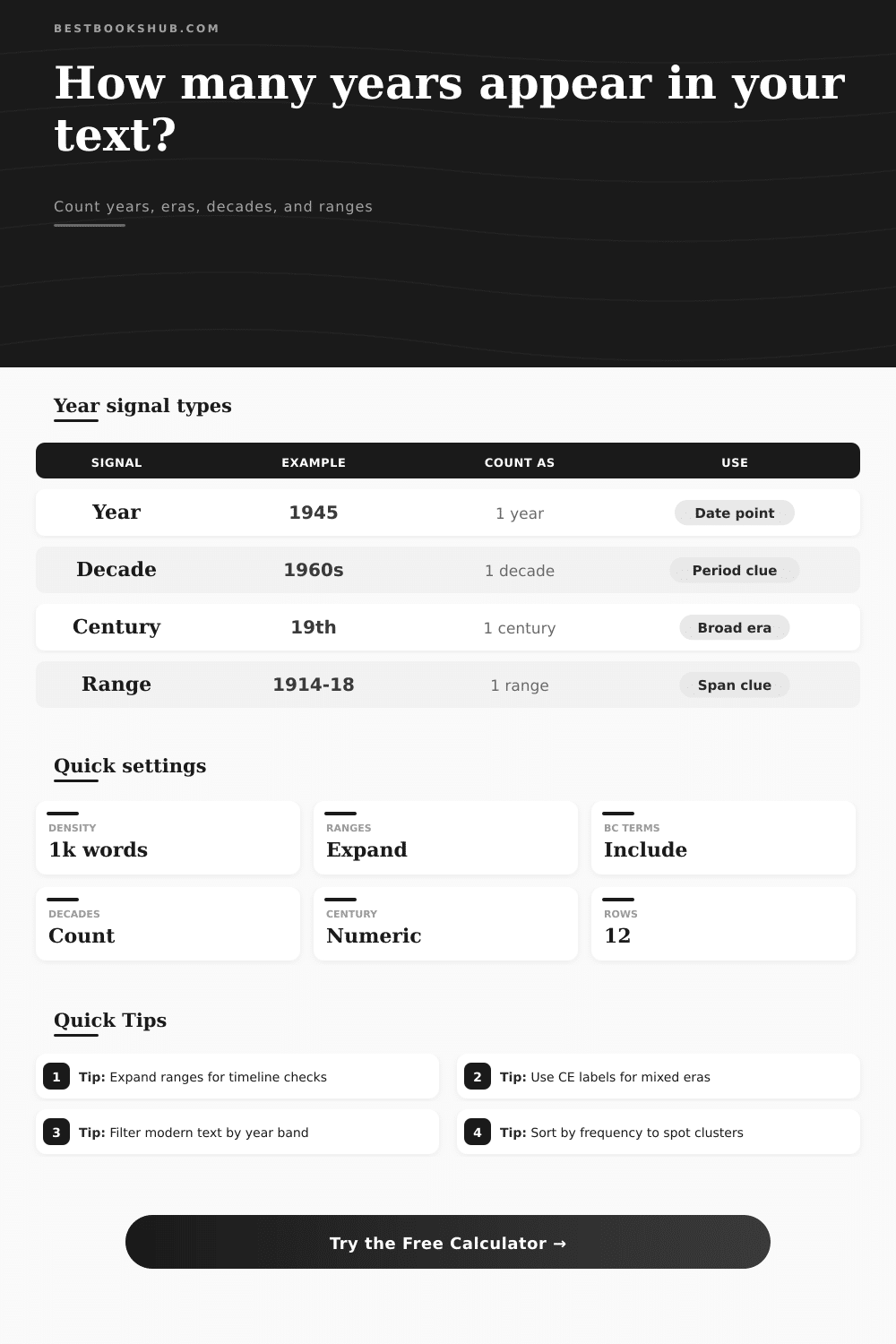
| Year | 1997 | Standalone 4-digit number | Counts as one normalized year point |
| Era | 44 BCE, AD 410 | Era marker before or after a year | Attached to the nearest year mention |
| Range | 1914-1918, 1939 to 1945 | Two date endpoints with a range joiner | Counts both endpoints unless changed |
| Short range | 1914-18 | Second endpoint has 2 digits | Expanded into the same century as start |
| Decade | 1960s, the 90s | Year-like decade wording | Counts as a separate decade mention |
| Century | 19th century | Ordinal number plus century | Counts as a broad period signal |
| Density band | Per 1,000 words | Typical text | Reading signal |
|---|---|---|---|
| Light | 0.1 to 2.0 | Fiction scene, essay paragraph | Dates are occasional anchors |
| Moderate | 2.1 to 8.0 | Biography, historical overview | Chronology shapes the passage |
| Dense | 8.1 to 20.0 | Timeline, index, notes page | Date scanning becomes important |
| Very dense | 20.1+ | Chronology list, archive metadata | Text is mostly date-structured |
| Century mention | Year span | Common form | Counter note |
|---|---|---|---|
| 18th century | 1701-1800 | Enlightenment-era notes | Broad period, not a single year |
| 19th century | 1801-1900 | Victorian or Romantic studies | Useful for era-heavy chapters |
| 20th century | 1901-2000 | Modern history summaries | Tracks broad chronology claims |
| 21st century | 2001-2100 | Contemporary text analysis | Can sit beside exact years |
DISCLOSURE: This post may contain affiliate links, meaning when you click the links and make a purchase, I receive a commission. As an Amazon Associate I earn from qualifying purchases.
Does your timeline make sense? Is it accurate? Yes, but there’s more to it: Does your timeline have any bearing at all on the events? You don’t need to know the exact date that an event occurred unless it has some significance for the story. Unless you’re making a statement about passage of time, one year establishes a moment and nothing more. A page packed with year mentions becomes a ledger. But then again, a ledger is a kind of book, too.
And the way a book treats time isn’t accidental. Because the number of times the word “year” appears on this page doesn’t simply add up. It adds up to something. Something you can measure: how dense your use of time is on the page. This tells us whether we’re reading a bibliography disguised as prose or actual literature.
How to Use Dates in Your Story
The second is that not all time signal are made equal. For example, “in 1945” is a precise point. It is easy to index and sharp. “In the 1960s” is a decade. Decades suggest a mood: a cultural backdrop, more so then a specific event. Your job, the task you’re asking this tool to do when you paste your text in, is to distinguish texture here.
And your answer, through the settings, will depend on how strict you wish to be. Do you count BC/AD labels as distinct eras? Maybe. That’s noise you could add to your total. Or maybe you choose to ignore them. Then you risk missing structural bones of some ancient history text. It depends on what you aim to prove.
Are you testing for factual consistency? Or are you analyzing how many times the author pause to remind you about when things happened? And then think about range. You might count something as a single event with a range of 1914-18, but expand it into five different years. Because if you’re looking for clusters, it makes a difference. And if your manuscript talks about 1915 repeatedly, say four times, and fills in the remainder of the war broadly, then the expansion setting will highlight that for you. Otherwise the war appear as a solid block of text. But with the expansion, you see the gaps.
That’s when the tool moves from being just a counter to being an editing assistant: helping you locate places where you’ve over-explained a moment and under-explained another. The best metric for self-editing, though? Density. Specifically: how many mentions there is per thousand words.
Low density indicates dates as part of the narrative flow; they’re like faintly heard background music. That’s typically fine when you’re writing fiction. For the nonfiction author, high density mean that the text is date-driven. That makes sense with analytical nonfiction, notes, and indices. If you have a higher density than you’d prefer, but are writing fiction, then… You may well be telling the reader more than you need to. Telling them too much can stop the story in its tracks while you look at a calendar.
To understand what “light,” “moderate” and “dense” look like in practice, see the reference table on the page. Then there’s the issue of date labels (BC, AD). Mixing BC and AD dates can confuse the parser if you aren’t careful. With this tool, though, you can label each with its closest year and it will stick with that year. That maintains the purity of the data. It doesn’t let a random CE tag float around as an out-of-place signal.
That’s the difference between a mere word counter and a proper timeline analyzer. It’s not about how many words. It’s about tracking the time-based structure of your argument. And then note the total mentions and the unique years in the breakdown. Ten unique years, 50 mentions? It is repetition. Is that intentional emphasis? Or is it redundancy?
Intention is out of tool’s hands, but repetition isn’t. Do those repetitions serve your story? Decide for yourself. Most times, they don’t. We’re inclined to drop too many dates, like breadcrumbs on a timeline, when one signpost will do.
In the end, however, it’s all about control. How long do you want the story push up against? Do you need more anchors? Less? If the number is large, go easy; if small, make sure you’ve got plenty of markers so the reader doesn’t get lost. Leave the math for the calculator and use the result to concentrate on what matters.
Make those invisible pacing problems visible data, then tweak the flow once you’re seeing the weight. When there’s too many dates and too little drama, ease them out and even them off. Balance is name of the game: let dates support but not bear the story.