📖 Annual page tracker
Yearly Page Count Calculator
Forecast total pages read this year from books finished, average pages, daily page pace, monthly reading pattern, rereads, and optional audiobook page equivalents.
Load a realistic yearly page-count setup, then adjust the finished books, page average, daily pace, monthly pattern, reread share, and audiobook conversion rule.
| Format profile | Typical pages | Best average to enter | Counting note |
|---|---|---|---|
| Novellas and short novels | 120 to 260 pages | 180 to 220 pages | Book count rises quickly; page goal may still need daily pace. |
| Commercial fiction | 280 to 420 pages | 300 to 340 pages | A steady default for most mixed fiction trackers. |
| Long fantasy or classics | 500 to 900 pages | 600 to 700 pages | Expect fewer finished books for the same page total. |
| General nonfiction | 300 to 480 pages | 340 to 400 pages | Notes and pauses may lower practical pages per day. |
| Graphic novel or manga | 120 to 220 pages | 160 to 190 pages | High page totals may represent lower text density. |
| Pattern | Multiplier | Use when | Effect on forecast |
|---|---|---|---|
| Busy months ahead | 0.75x | School terms, travel, deadlines, or low energy months | Reduces future page pace by one quarter. |
| Slight slowdown | 0.90x | Routine is mostly stable but interruptions are likely | Trims the forecast without assuming a slump. |
| Even pace | 1.00x | Your recent page rhythm should continue | Keeps pages per reading day unchanged. |
| Reading season lift | 1.10x | Quieter evenings, vacations, or colder months help | Adds a modest lift to remaining pages. |
| Sprint finish | 1.50x | Short challenge push or final-month catch-up | Useful for short periods, risky for long windows. |
| Conversion rule | Pages per hour | 10 audio hours | Best fit |
|---|---|---|---|
| Do not count audio | 0 pages/hour | 0 pages | Print-only page logs or separate audio tracking. |
| Conservative listening | 30 pages/hour | 300 pages | Dense nonfiction, note-taking, or slower narration. |
| Standard conversion | 35 pages/hour | 350 pages | Most fiction and memoir listening trackers. |
| Fast narration | 45 pages/hour | 450 pages | Familiar genres, faster playback, or light prose. |
| Custom rule | User entered | Varies | Use when you know your edition or app statistics. |
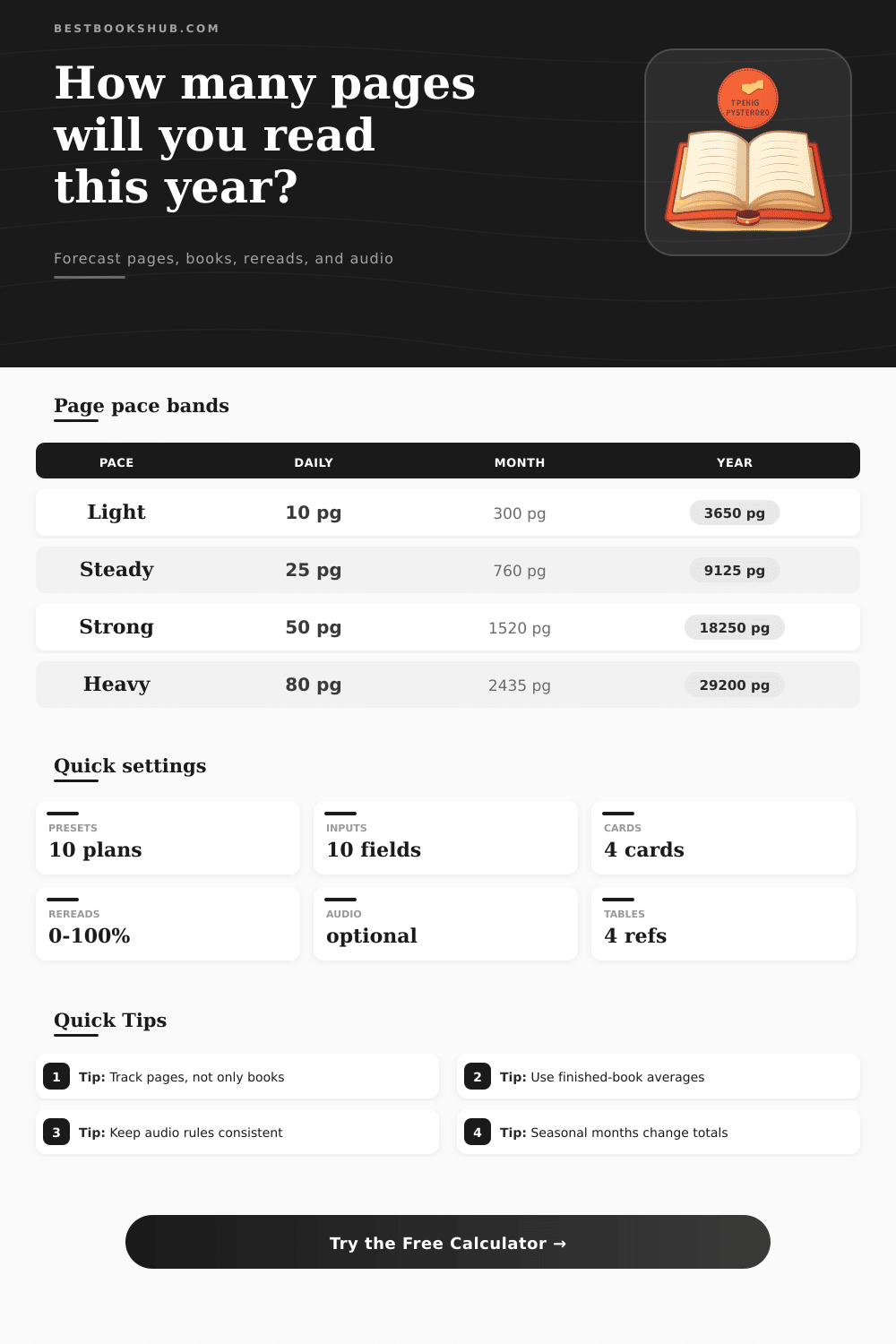
| Reader pace | Pages per reading day | At 5 days/week | Approx yearly pages |
|---|---|---|---|
| Light page year | 10 pages | 50 pages/week | About 2,600 pages from future pace. |
| Steady page year | 25 pages | 125 pages/week | About 6,500 pages from future pace. |
| Strong page year | 50 pages | 250 pages/week | About 13,000 pages from future pace. |
| Heavy page year | 80 pages | 400 pages/week | About 20,800 pages from future pace. |
DISCLOSURE: This post may contain affiliate links, meaning when you click the links and make a purchase, I receive a commission. As an Amazon Associate I earn from qualifying purchases.
At the beginning of the year, you made yourself a list of books you needed to read. In March, the list slip from memory and became fuzzy hopes. In June, it become something you think about as you scroll through your phone, but never open up in an app. Motivation isn’t typically the issue. It’s math.
Readers who don’t meet their yearly reading goals aren’t necessarily people who have no time; they’re people who mistake page count for book count. A book that take one hundred pages reads the same in their minds as a book that require eight-hundred. If you keep track of pages instead of titles, you’ll find out what happens when life get hectic. That’s where this little calculator come in.
A Tool to Help You Reach Your Reading Goals
It separates out what you’ve already achieved from what you want to achieve and does all the math for you. The single most significant piece of data you’ll input isn’t how many books you finish, but rather how many pages on average those book contain. That’s your anchor for everything else. You may finish a lot of short mystery novels, which would bring your average down to maybe two hundred fifty pages. Or perhaps you’re reading a bunch of historical fiction, which can easily runs above four hundred pages. Your average will determine whether your daily requirement feels easy or not, and you need to get it correct.
A smaller number (fewer pages per book) feel like an easier goal… until you realize you’ll need so many books to reach that high page total. The books are important, yes, but so is your routine. It prompts you to set both active reading days (per week) and planned pages (per reading day). Why? Because that way you can’t overpromise.
Maybe you want to shoot for fifty pages a day. But maybe you read only five days a week? That’s quite a difference from a reader who reads each night of the week. The average person overestimates how consistent he’ll be, thinking: “Yeah! I’m going to read perfectly until vacation, work deadline, and being sick.” The fact is, you won’t. And the monthly tool for choosing patterns recognizes that.
You can dial it up for a month when you’re on a summer reading challenge, or tone it down if you’re having a busy month at work. It knows that reading isn’t static; its seasonal. But then there’s this thing called audiobooks.
These are tricky because they throw a wrench into a straightforward tracker: You can’t just assume that listening time translates directly into pages read. But if we don’t include audio? Well, then we’re neglecting a huge amount of today’s reading. To deal with audiobooks, the calculator provides some rules for converting (depending on density, how fast the narrator speaks). In general, it has 35 pages per hour as default; that will be fine for most fiction, but it might fail for something like a dense academic text or a fast-paced thriller. It would of made more sense to pick one rule and go with it. But also, it’d give us a set of data that could mean something. This is true even if the numbers aren’t exact.
Similarly, rereading falls into this trap. You’re adding more pages to the number, but no new stories to your library. With the tool, you can distinguish between new and reread pages, which will give you a better sense of what you actualy read compared to how much you reread for comfort. That’s helpful so that you can see if you really expanded your horizons (or just spun your wheels in a comfortable place). Both are good things. But each is there for a slightly different purpose based off an annual recap.
The point, though, is to predict where you’ll land before you get lost. Plug in some reasonable averages, dial down for the seasons when things slow down, then factor in your own haphazardness. What feels unrealistic (ohmygod, I’m never going to read ten thousand pages!) breaks down into something more approachable once you realize that means only half an hour every evening. The math helps show the scale of this ambition: how many will you wind up reading? Five? Fifty? Pages will reveal the shape of your year.
Try a truthful average, then tweak for upcoming hectic periods, then give the page count permission to set your speed. Not the other way around.