🏃 Yo-Yo Test Score Calculator
Enter your Yo-Yo test level and shuttle count to instantly calculate your VO2 max, total distance, and fitness rating
🏆 Your Yo-Yo Test Results
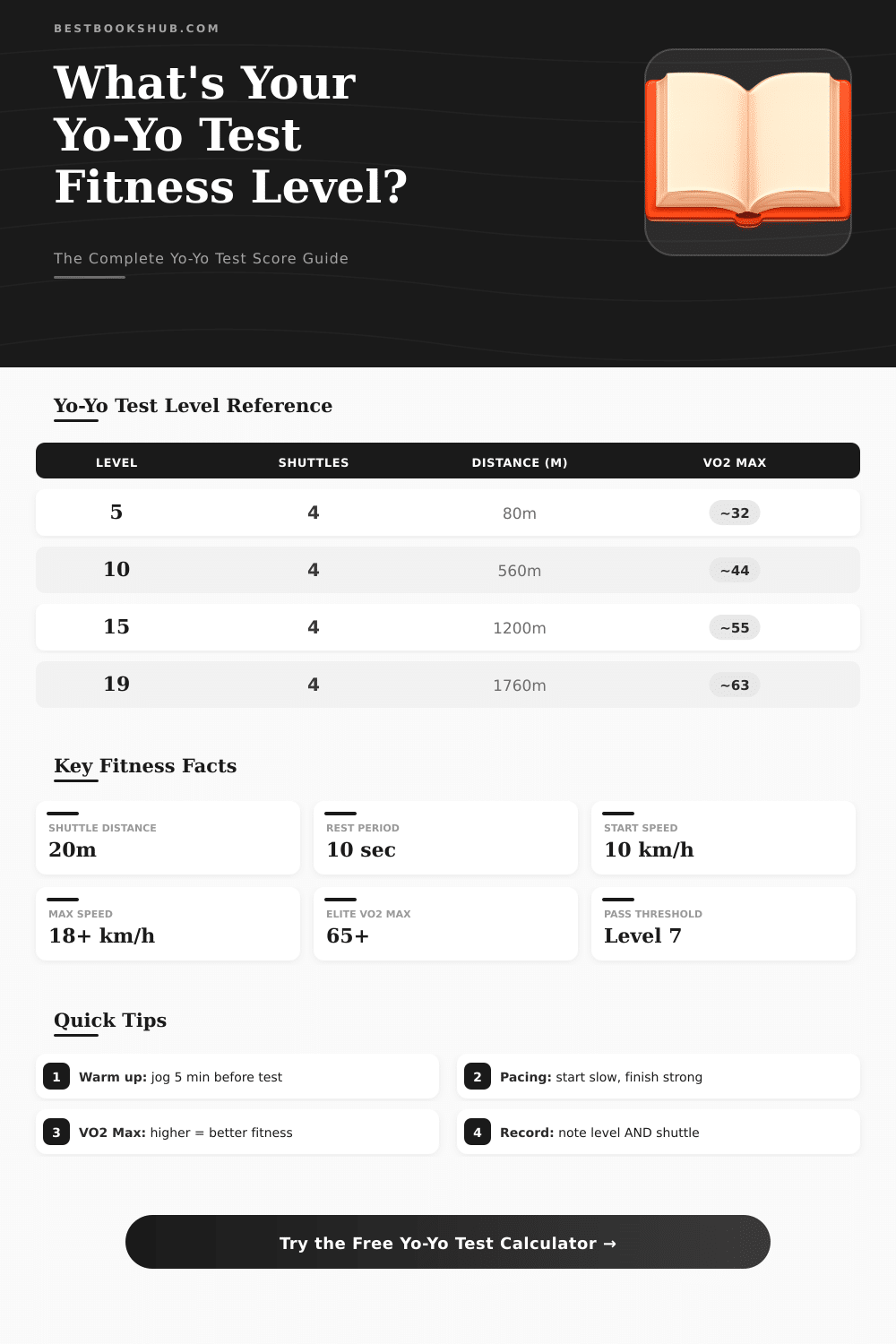
| Level | Shuttles per Level | Speed (km/h) | Cumulative Distance (m) | Est. VO2 Max |
|---|---|---|---|---|
| 5 | 8 | 11.0 | 160m | ~32.9 |
| 6 | 8 | 11.5 | 320m | ~36.4 |
| 7 | 8 | 12.0 | 480m | ~38.8 |
| 8 | 8 | 12.5 | 640m | ~41.0 |
| 9 | 8 | 13.0 | 800m | ~43.1 |
| 10 | 8 | 13.5 | 960m | ~45.0 |
| 11 | 8 | 14.0 | 1120m | ~46.9 |
| 12 | 8 | 14.5 | 1280m | ~48.7 |
| 13 | 8 | 15.0 | 1440m | ~50.4 |
| 14 | 8 | 15.5 | 1600m | ~52.0 |
| 15 | 8 | 16.0 | 1760m | ~53.6 |
| 16 | 8 | 16.5 | 1920m | ~55.1 |
| 17 | 8 | 17.0 | 2080m | ~56.5 |
| 18 | 8 | 17.5 | 2240m | ~57.9 |
| 19 | 8 | 18.0 | 2400m | ~59.3 |
| 20 | 8 | 18.5 | 2560m | ~60.6 |
| 21 | 8 | 19.0 | 2720m | ~61.8 |
| 22 | 8 | 19.5 | 2880m | ~63.1 |
| 23 | 8 | 20.0 | 3040m | ~64.3 |
| Sport | Average Score (IR1) | Good Score (IR1) | Elite Score (IR1) | VO2 Max Range |
|---|---|---|---|---|
| Football / Soccer | Level 14–15 | Level 16–17 | Level 18+ | 52–65 |
| Rugby | Level 12–13 | Level 14–15 | Level 16+ | 48–60 |
| Basketball | Level 13–14 | Level 15–16 | Level 17+ | 50–62 |
| Field Hockey | Level 12–14 | Level 15–16 | Level 17+ | 48–60 |
| Cricket | Level 9–11 | Level 12–13 | Level 14+ | 42–52 |
| Tennis | Level 11–13 | Level 14–15 | Level 16+ | 46–58 |
| Military / Police | Level 10–12 | Level 13–14 | Level 15+ | 44–55 |
| General Fitness | Level 7–9 | Level 10–12 | Level 13+ | 38–50 |
| Total Shuttles | Distance (m) | Distance (yards) | Approx. Level | Fitness Category |
|---|---|---|---|---|
| 4 | 80m | 87.5 yds | ~5 | Very Low |
| 16 | 320m | 350 yds | ~7 | Low |
| 32 | 640m | 700 yds | ~9 | Below Average |
| 48 | 960m | 1050 yds | ~11 | Average |
| 64 | 1280m | 1400 yds | ~13 | Above Average |
| 80 | 1600m | 1750 yds | ~15 | Good |
| 96 | 1920m | 2100 yds | ~17 | Very Good |
| 120 | 2400m | 2625 yds | ~19 | Excellent |
| 144 | 2880m | 3150 yds | ~22 | Elite |
The yo-yo test is a fitness assessment: install two cones that mark lines 20 meters apart. You jog quickly between them, but the challenge comes when the interval between beeps shrinks while you progress. The athlete gets a score until the moment you can no longer keep the pace, especially after two lost beeps twice in a row.
DISCLOSURE: This post may contain affiliate links, meaning when you click the links and make a purchase, I receive a commission. As an Amazon Associate I earn from qualifying purchases.
That means you failed to end the shuttle before the third beep sounds. What separates it from the beep test is the integrated rest period. After every 40 meters of run the athletes pause for a breath, rather than the beep test that lasts without suspension.
How the Yo-Yo Test Works
Someone in good form ends the whole test between 10 and 20 minutes. During that time you cover distance between 1.2 and 2.5 kilometers. The score you log is twofold, as raw distance or as levels, according to what the audio track counts.
You can convert them also into a rating of VO2max, very useful for control aerobic training. There are two versions: the IR1 and IR2, each with its own formulas for the numebsr. For the IR2 the calculation goes like this: take your last distance in meters, multiply by 0.0136, later add 45.3 to have the approximate VO2max.
If someone does not end even one full cycle, the minimal standard stands at 36.4 for IR1 or 45.3 for IR2.
The scales reach maximum at level 23. In the YYIR1 the performance ranges from level 5 until 23. Most women end around level 12, men close to 16.
Under 400 meters you consider a bad result. At 18.7 or more in level 1 you have something that most would call excellent. You use most commonly the YYIR1, but do not wonder if you find results of YYIR2.
Funny: some basketball players surpassed 23, it raised eyebrows, until you found that they did the YYIR2, which starts more quickly, so it is possible to reach high points without too much run territory.
Indian cricketers made that test a main tool for control training. When Anil Kumble introduced it as coach, it quickly became popular and soon became compulsory for the team. Then the minimal limit was only around 15, because many players yet did not become acquainted with it.
Other countries already reached 16 or 17, but India had to adapt to its athletes. Now the strict bar is 16.5. Virat Kohli acted as a standard-setter in the crew and reached 19.
Nitish Kumar Reddy surpassed with 18.1. Meanwhile, Pakistani Shan Masood marked the record for cricket; 22.1.
The test results are faithful also in repetitions. For the IR1 the correlation coefficient and variety is 0.93 and 8.1 percent, for IR2 0.97 and 10.4 percent. If you use the results to trace progress of an athlete or compare them, control carefully the test provisions.
Without strict arrangement real improvements in fitness can pass unnoticed.