📊 Yule K Calculator
Measure vocabulary diversity and lexical richness with Yule's K statistic
| Text Type | Typical Yule K | Vocab Diversity | Notes |
|---|---|---|---|
| Literary Fiction | 30–80 | Very High | Rich, varied word choice |
| Academic Papers | 60–120 | High | Specialized but varied |
| News Articles | 80–150 | Moderate–High | Broad general vocabulary |
| Blog / Web Content | 100–180 | Moderate | Topic-dependent variation |
| Children's Books | 120–200 | Moderate–Low | Simple, repeated vocabulary |
| Legal Documents | 150–250 | Low–Moderate | Formulaic repetition |
| Technical Manuals | 180–300 | Low | High term repetition |
| Conversational Speech | 200–350 | Very Low | Filler words dominate |
| Symbol | Name | Definition | Example |
|---|---|---|---|
| N (M0) | Total Tokens | Total word count (with repeats) | 1,500 words total |
| V(m, N) | Frequency Spectrum | Count of words appearing exactly m times | V(1,N) = hapax count |
| M2 | Second Moment | Σ(m² × V(m,N)) for all m | Sum of freq-squared |
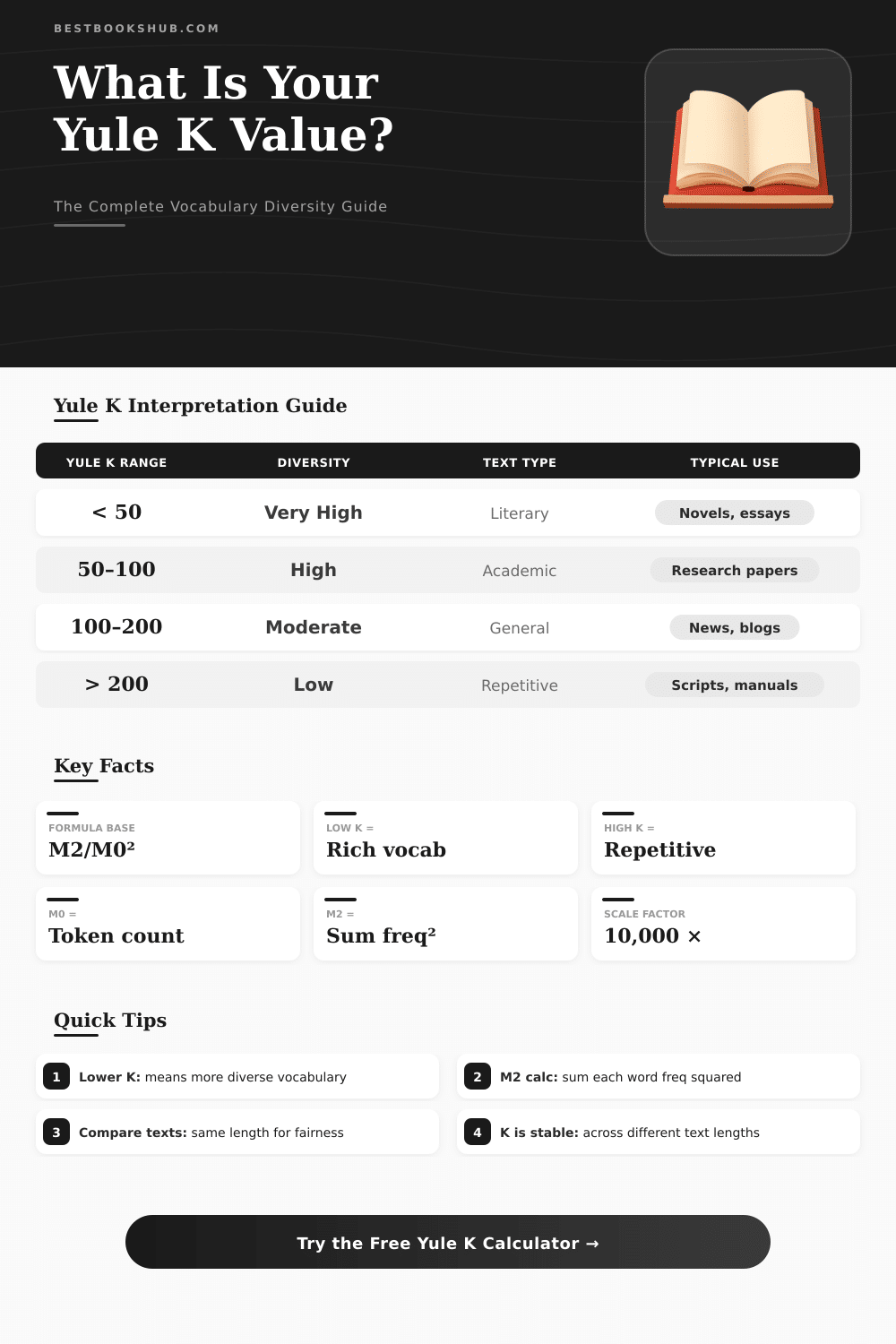
| K | Yule's K | 10,000 × (M2 – M0) / M0² | Lower = more diverse |
| TTR | Type–Token Ratio | Unique words / Total words | Complementary measure |
| I (Yule's I) | Inverse K | 1 / K (higher = more diverse) | Often used in stylometry |
| Frequency Class | Linguistic Term | Contribution to M2 | Typical % of Vocab |
|---|---|---|---|
| Appears 1 time | Hapax legomena | 1 per word | 40–60% of unique words |
| Appears 2 times | Dis legomena | 4 per word | 10–20% |
| Appears 3–5 times | Low freq words | 9–25 per word | 10–15% |
| Appears 6–20 times | Medium freq words | 36–400 per word | 5–10% |
| Appears > 20 times | High freq / function words | >400 per word | 1–5% |
DISCLOSURE: This post may contain affiliate links, meaning when you click the links and make a purchase, I receive a commission. As an Amazon Associate I earn from qualifying purchases.
Yule K is a simple, quick way to estimate amount of vocabulary diversity within any text. There’s even a free Yule K calculator that spits out results immediately! Just type in your text (or frequency data), and you’ll recieve precise Yule K and Yule I estimates.
What you may observe is that one book feels alive with fresh words while another keeps circling the same handful of terms. Linguists call this experience richness, and they have a statistic (called the K statistic by Yule) to express that experience as a concrete figure. That way we can rate any two texts against each other no matter their length.
What Is Yule K?
The reason it’s effective is because it doesn’t count just the total number of different words but also the number of repetitions of those words. Each time a word show up counts very little towards the end result. Instead, words that shows up more raise the number rapidly. That’s why the calculator requests the sum of squared frequencies (or the raw text). Squaring the frequency gives greater importance to repetition, allowing us to see if an author stick to old ground or brings in new expressions.
This concept isn’t new; it’s been kicking around among writers for decades. In the 1940s, George Udny Yule needed an approach to studying authorship that didn’t alter based off the sample size. He came up with one that held strong. Whether you measure the K value from a long novel or a brief letter, you’ll find similar results if both are authored by the same writer. That’s unusual with linguistic measures. Many of the simpler ratios falls apart as text grows shorter than longer.
The usefulness of this becomes clearer if we contrast different types of writing: For example, literary fiction tends to fall on the lower end (below 80), as novelists are not trying to repeat themselves. Academic papers tend to be above 80; repetition is necessary in order to make sure things are clear, but good scholars will vary their phrasing sufficiently so they remains within a moderate range. Blog posts and news stories stay around the 100-180 range. That’s where journalism tries to find the sweet spot every day, between being readable and precise. Legal contracts and technical manuals has a tendency to creep above 200. Here, it’s precision by rote repetition.
It handles real world messiness well. For example, you’ll probably find that K is higher for a messy first draft than it is for a final polished piece. Why? Because conversation includes lots of filler words, the score jump if you run the exercise on spoken transcripts. There’s a reason children’s stories are higher up than adult fiction. Authors purposely reuse basic words to teach young readers the new words they need to know through repetition. This is no judgement of quality. It’s just showing how language feels.
A common mistake I’ve seen is that people grab wildly different lengths & compare them as if they’re equal. Don’t compare a 2000-word essay to a 200-word tweet thread. The calculator helps remove the guessing part when you input correct word counts. But the art are in selecting samples you can meaningfully compare in the first place. Select chapters of roughly-equal length from various books. Instead of reading whole papers, look at research abstracts. Get close to context and then let the numbers tell the story.
Precision and surprise are rewarded with lower scores. Repeats dilute their effect, dragging that last K down another notch. If you’re comfortablely working with a small palette, higher scores will reflect it. This is ideal for brand guidelines or instructional texts where consistency is most important. Neither approach are necessarily better. Knowing how your own words tend to land (and if it aligns with your intent) is the real benefit here.
Scroll down to the page and play around with the presets, in no time at all, you’ll have an ear for how certain K ranges sound. Pretty soon you won’t even need the exact number. You start to know when a paragraph has became too comfortable with its own set of vocabulary, and when it’s time to stretch out and grab something fresh. That’s when that statistic stops being abstract math and turns into a real-life craft tool.
So finally, in the case of Yule’s K: each choice of words is also a choice about patterns. And the calculator doesn’t do more than hold up a mirror for us to reflect on those patterns and see if we like them or not.